

It’s All About Type K


Recent Posts





Thermocouples are a popular and efficient instrument used for industrial and household purposes to ensure a reliable temperature measuring process. They are accurate, highly responsive, and most importantly, do not break your bank to ensure precision in sensing temperature! Though you would find different types, thermocouples type K is the most used one because of its precision, wide temperature range, and higher accuracy.
No matter if you need it for manufacturing, quality assurance, process industries, or household appliances, to get the most out of the instrument, you need to gather comprehensive knowledge about it.
To offer you a precise idea about type K thermocouple, I have gathered every essential aspect of this widely used electrical equipment.

Type K Thermocouple
Definition
If you are wondering about what a Type K thermocouple is, let me clear this fact. Type K thermocouple is a temperature sensor that senses temperature depending on the thermoelectric effect between two alloy conductors: Chromel and Alumel. It complies with the output requirements described in BS EN 60584 or ANSI/ASTM E230 specified for Type K.
This temperature sensor measures voltage, an electric parameter, and converts it to temperature, a non-electric parameter.
It comes in various forms: a surface sensor, immersion sensor, or a single cable/wire.
Composition
The composition of the positive and negative legs of Type K thermocouple is:
- Positive Leg: About 10% Chromium and 90% Nickel
- Negative Leg: About 1% Silicon, 2% Manganese, 2% Aluminium, and 95% Nickel
Chromel and Alumel are the positive and negative legs, respectively, and this combination makes this type of thermocouple exhibit sensitivity around 41 microvolts per degree Celsius.
Nickel, the prominent constituent of Type K thermocouple, is a ferromagnetic material that may exhibit a change in the output temperature when it arrives at Curie temperature specified for Type K (approximately 185°C).
Type K Thermocouple Colour Code
The IEC colour Code specified for Europe and the UK may appear simple to understand, but they require your utter conscience.
The IEC colour code for thermocouple Type K is:
- Green insulation in the positive leg
- White insulation in the negative leg
- Green insulation in the jacket
- Green coloured thermocouple connector housing
Are you afraid of messing this code with the KCA/KCB compensating cables as they also have the same coloured insulations? For identifying the Type K thermocouple accurately, use the magnetic test in its highly magnetic negative leg.
Working Principle and Diagram of Type K Thermocouple
Like other types of thermocouples, Type K also works based on the Seebeck effect. This thermoelectric effect takes its name after the inventor, the great German researcher, and scientist Johann Seebeck.
Seebeck Effect
According to Seebeck Effect, when a closed-loop is produced by connecting the two junctions of two dissimilar conductors, for Type K thermocouple, Chromel, and Alumel, and a temperature difference gets induced between these ends, there produces an electromotive force (EMF) inside the loop.
Diagram
The diagram of a Type K thermocouple is as follows:
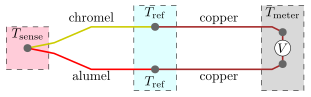
Measuring Temperature with a Type K Thermocouple
Let’s get an in-depth overview of how it can sense temperature.
The Type K thermocouple circuit consists of two different metal terminals and a voltage scaling device.
- These two dissimilar junctions are kept at two varying temperatures, and hence, a thermoelectric effect gets produced between them.
- As a result, temperature-variant electricity flows through this closed circuit.
- The measuring point, also known as the ‘hot junction,’ gets connected to the measuring instrument end, and the other end, the reference junction, is kept at a known temperature. Previously, the reference junction was denoted as the ‘cold junction’ and kept at 0°C. In modern thermocouples, the temperature of the known terminal gets compensated and standardised electrically.
Ways of Collecting Data from a Type K Thermocouple
You have the following methods for collecting the values:
- Connecting the Type K thermocouple with a general voltmeter is enough for simple reading. You can use the Seebeck equation: E=SΔT for converting the voltage reading into temperature. Here, ‘S’ is the Seebeck coefficient, and ΔT is the temperature variation between the two terminals.
- For industrial purposes, using a data acquisition system is essential to save the values for future comparison.
- A software or ‘voltage to temperature’ converting circuit can do the task.
Advantages of Type K Thermocouple
The surpassing benefits of Type K thermocouple are:
- Exhibits almost linear relationship between voltage and temperature
- It does not get eroded under 1600°F.
- Type K thermocouple is cost-effective.
- It exhibits a higher accuracy rate over other types of thermocouples.
- It offers higher stability in results.
- It ensures precision even in rough environments.
- Type K thermocouple operates in a wide range of temperatures.
- It does not show any resistive issue in lead cables.
- Highly responsive and compact.
Disadvantages of Type K Thermocouple
The minor downsides of Type K thermocouples are:
- It is less accurate than resistance temperature detectors (RTDs).
- Sensitive to Electromagnetic interference (EMI).
- May show corrosive nature over time.
- The outputs are not specifically linear.
No matter if you need HVAC temperature sensors or ceramic ones, you need to buy from a reliable source that can match your designs and requirements and supply high-class industrial-grade products. If you want top-quality thermocouples complied with BS EN 60584 regulatory terms, Process Parameters can be your ultimate choice. They provide the customers with a wide variety of thermocouples for an extensive spectrum of uses.
Type K Thermocouple Temperature Range
Type K thermocouple can operate at a wide range of temperature from –326°F to 2300°F (-200°C to 1260°C).
Some points to keep in mind here are:
- You have to use a Type K thermocouple made of a specific material to measure the temperature under 0°C.
- The highest operating temperature of this type of thermocouple is a variant of its diameter.
Voltage-Temperature Chart of Type K Thermocouple
Though type K thermocouple exhibits an almost linear relationship between the voltage and the varying temperature, it is not entirely linear. Hence, you have to use a voltage-temperature chart to find the temperature relative to the EMF generated.
Here is a pdf by ReoTemp that shows a table of the lowest temperature limits:
https://www.thermocoupleinfo.com/pdf/type-k-thermocouple-reference-table.pdf
Conclusion
Thermocouples Type K is the most viable and cost-effective option among the temperatures sensors out there that exhibits higher sensitivity and accuracy rate irrespective of the severe atmosphere. The comprehensive overview I have offered here would help you gather precise knowledge about this highly efficient temperature sensor and use it wisely, be it in chemical medium, gases, or electric appliances.

Managing Director at Just 4 Programmers
Kayleigh Baxter is the Managing Director of Just4Programmers.com, a leading software development company and proud Microsoft Gold Partner. With extensive expertise in Microsoft technologies and Amazon Web Services, Kayleigh has guided Just4Programmers to become a beacon of innovation and technical excellence in the industry.
Latest posts by Kayleigh Baxter (see all)
